NYC’s Record Rent Gap Is Now a $70,000 Behavioral Lock
New data from StreetEasy, Zumper, and RentReboot shows the penalty for moving in NYC has never been higher — and it is reshaping the market in ways that will compound for years
By Jimmy Lo
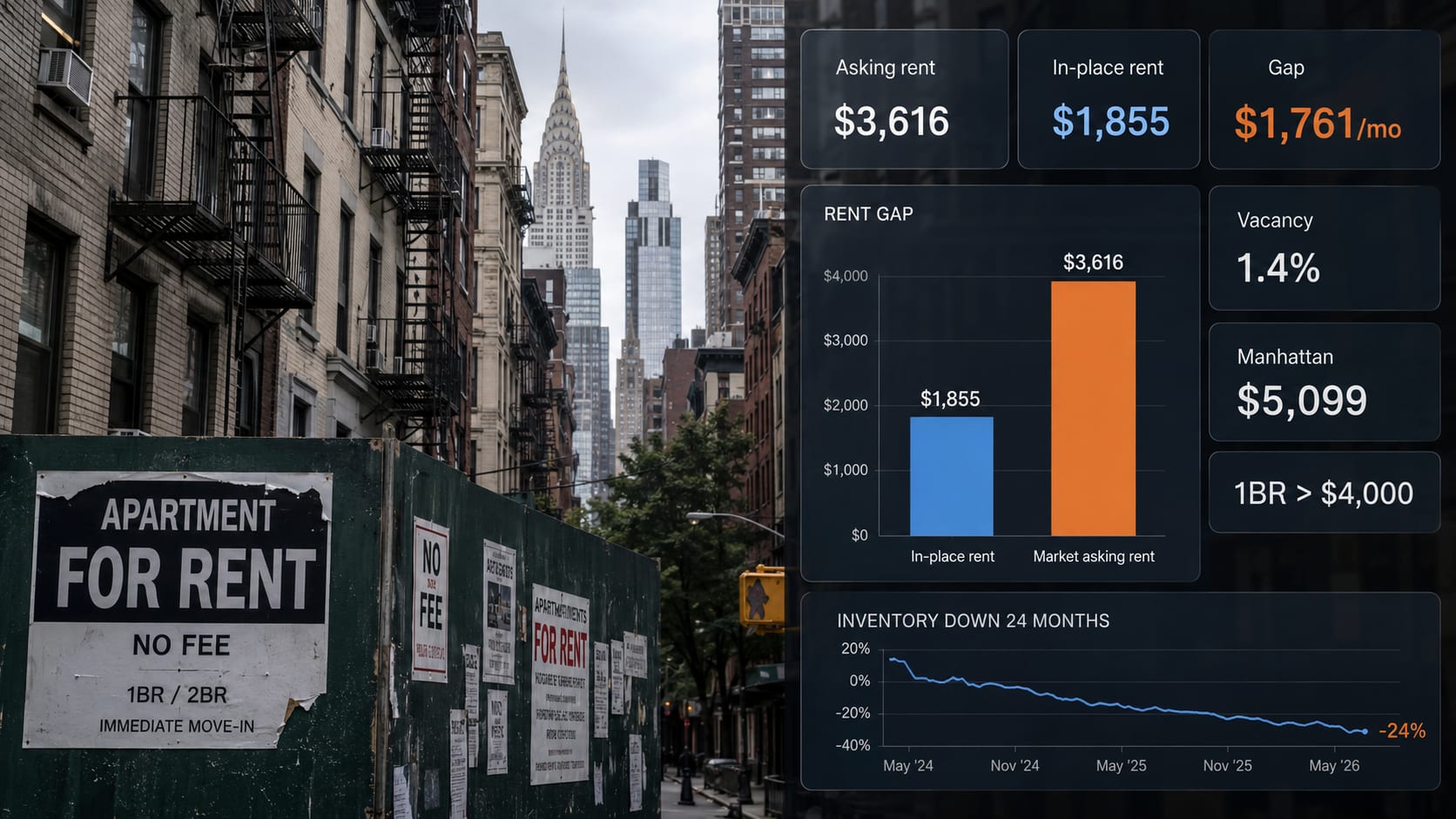
New data from StreetEasy, Zumper, and RentReboot confirms what many NYC renters already sense: the financial penalty for moving has never been higher. As of the week ending May 17, 2026, the gap between in-place contract rents (~$1,855/month) and market asking rents ($3,616 citywide) stands at a record $1,761/month — equivalent to $21,132 per year, or roughly $70,440 in additional pre-tax income needed just to maintain a 30% rent-to-income ratio if you move. This is not just an affordability number. It is a behavioral lock that is reshaping the NYC rental market in ways that will compound for years.
What the Numbers Signal
The headline figures for May 2026 tell a stark story:
- Citywide median asking rent: $3,616 (+6.2% YoY)
- Manhattan median asking rent: $5,099 — a new all-time high
- NYC 1BR median: Crossed $4,000 for the first time ever
- Rental vacancy: 1.4% — the lowest since 1968
- Manhattan rental inventory: Down for the 24th consecutive month, the longest streak in StreetEasy's 20-year history
The vacancy and inventory data are the most telling. A 1.4% vacancy rate is not a tight market — it's a locked market. At this level, even small shocks to demand (a wave of in-migrants, a surge of household formation among recent graduates) would face virtually no supply buffer.
Why It Matters
The rent gap creates a powerful status quo bias among existing tenants. When the cost of moving is equivalent to a $70,000 income raise, rational renters stay put — even if their current apartment is too small, poorly maintained, or no longer geographically convenient. This suppresses turnover, which in turn suppresses the supply of available units on the open market, which pushes asking rents even higher. It is a self-reinforcing cycle.
For investors and landlords, the flip side is equally powerful. Every lease renewal captures the existing tenant at contract rent (often well below market), while every vacancy — however rare — can be re-let at a massive premium. The 24th consecutive month of falling inventory means that re-letting spreads remain wide and durable.
What It Means for the Housing Market
The Bronx, long treated as NYC's affordability safety valve, is no longer absorbing the pressure. The rent gap there has widened to $1,756/month — nearly identical to the citywide figure. When the lowest-cost borough loses its relative affordability advantage, the entire market is under stress.
The structural driver is well understood: new construction in NYC is running far below replacement levels. Only 81 new Manhattan residential units launched in Q1 2026, roughly 75% below the 10-year average. Without a dramatic increase in supply — which would require both zoning reform and a more favorable financing environment for developers — the rent lock-in dynamic will deepen, not ease.
Policy Implications
NYC's housing crisis has reached a point where incremental policy tools are unlikely to move the needle. Rent stabilization keeps a subset of tenants in place at contract rents (contributing directly to the gap), but does nothing for the millions of market-rate renters being priced out. The City of Yes zoning reforms are still working through implementation, and their real-world impact on supply will not be visible until 2027 at the earliest.
The more urgent policy question is: what happens to household formation when young professionals can no longer afford to move into the city? Early data suggests out-migration to transit-accessible suburbs — Westchester, Jersey City, Long Island City — is already accelerating. If that trend compounds, the labor market implications for NYC employers that depend on younger, less affluent workers could become significant faster than the housing data alone would suggest.
Tags