Every Stop Counts: How Taiwan's Pedestrian Yielding Penalty Cut Traffic Deaths by 40%
Published in Transport Policy, 2025 · A quasi-experimental study on traffic law enforcement and road safety

The Problem
Taiwan has one of the world's highest motorcycle densities — over 63% of registered vehicles are motorcycles, nearly one per resident. For years, international travel advisories warned visitors about Taiwan's pedestrian-hostile roads. CNN called it a "living hell for pedestrians." Motorcycles routinely failed to stop at crosswalks, and pedestrian fatalities were climbing.
On June 30, 2023, the Taiwanese government made a sharp move: it amended the Road Traffic Management and Penalty Act to require drivers to come to a complete stop before crosswalks, imposing strict monetary fines for non-compliance. No more slow-rolling. No more coasting through. You stop, or you pay.
The question this research asks: Did it actually work?
Methodology
We used an interrupted time series / regression discontinuity in time design, treating the June 30, 2023 policy date as the cutoff. Two statistical models were estimated:
A Poisson model for crash frequency (daily counts by crash type and severity)
A logistic regression model for crash severity (binary: fatal vs. non-fatal)
Natural spline functions captured seasonal and long-term time trends. Interaction terms tested whether the policy's effect differed by crash type, location, and lighting condition. Robustness checks used a negative binomial specification.
What We Found
Using a quasi-experimental design — essentially treating the law's rollout date as a natural experiment — we analyzed every road traffic incident in Taiwan from 2018 to 2023, over 2.5 million crash records in total.
The results were striking:
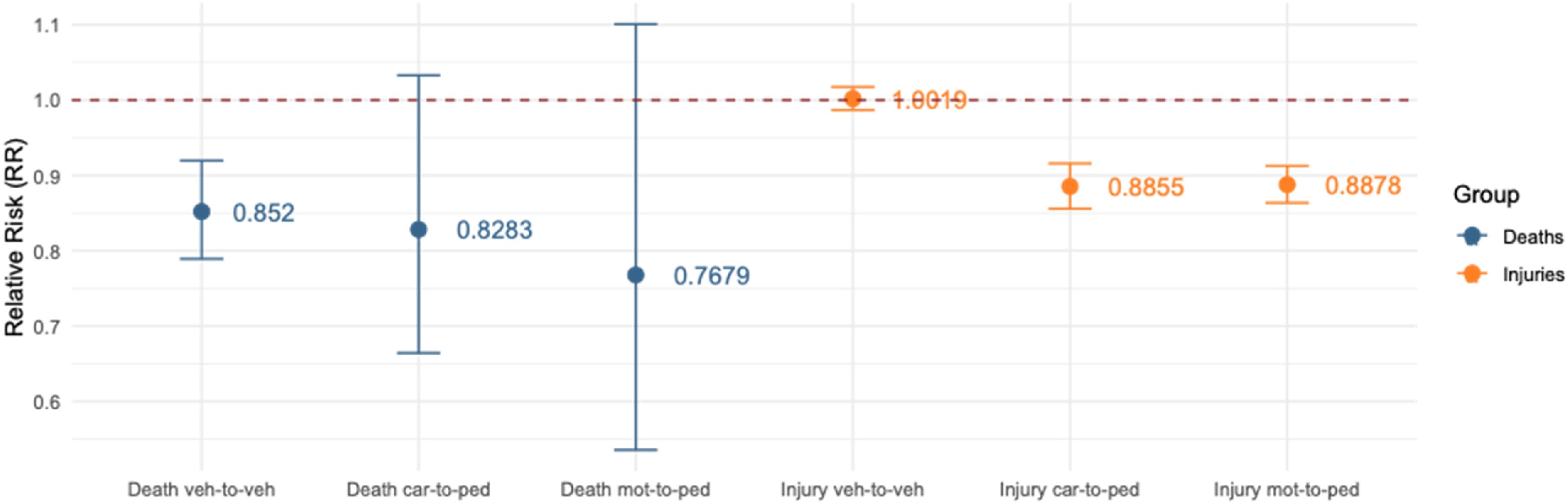
Fatal crashes dropped 40% immediately — the very day enforcement began (RR = 0.60; 95% CI: 0.42, 0.85). Drivers adapted fast, and the crashes that still happened were less likely to kill.
Pedestrian-involved injuries declined 11% over time for both car-to-pedestrian and motorcycle-to-pedestrian crashes — a slower but meaningful reduction as behavioral change became routine.
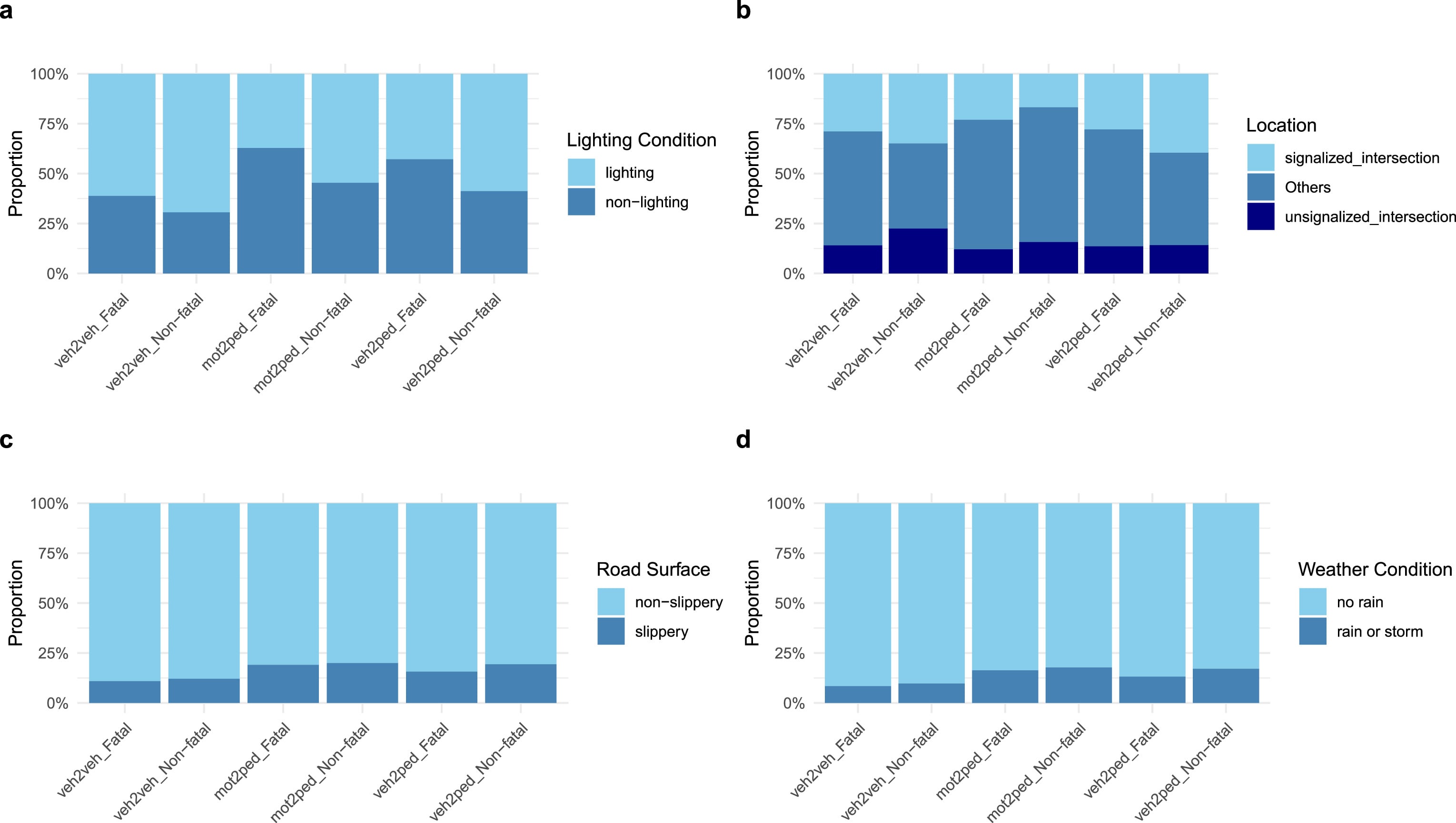
The effect was strongest in low-light conditions. Crashes in poorly lit, nighttime environments saw the biggest reductions in severity — the settings where pedestrians are most vulnerable.
Spillover to vehicle-to-vehicle crashes. Even crashes with no pedestrian involvement became less fatal — suggesting the law changed general driver vigilance, not just crosswalk behavior.
Why This Matters Beyond Taiwan
This study is one of the few rigorous evaluations of a nationwide, pedestrian-focused penalty policy. Most prior research focuses on city-level interventions in North America or measures behavioral proxies — not actual crash outcomes at scale.
The findings carry direct lessons for:
Southeast Asia and Latin America, where motorcycle dominance and weak yielding cultures mirror Taiwan's pre-2023 environment (Vietnam, Cambodia, Brazil, Colombia)
Any region implementing Vision Zero — the evidence shows penalties work, and they work fast for the outcomes that matter most: keeping people alive
Policy designers who often assume behavioral change is slow — this data shows that when financial stakes are raised, drivers respond to severity immediately, even if frequency reduction takes longer
Topics
Methods
Tools